| |  Hello, tech! This is the brainpickings.org weekly digest by Maria Popova. If you missed last week's edition — Ursula K. Le Guin on suffering and getting to the other side of pain, Beethoven on the creative process, George Sand's only children's book — you can catch up right here. And if you're enjoying this newsletter, please consider supporting my labor of love with a donation – each month, I spend hundreds of hours and tremendous resources on it, and every little bit of support helps enormously. If you already donate: THANK YOU. Hello, tech! This is the brainpickings.org weekly digest by Maria Popova. If you missed last week's edition — Ursula K. Le Guin on suffering and getting to the other side of pain, Beethoven on the creative process, George Sand's only children's book — you can catch up right here. And if you're enjoying this newsletter, please consider supporting my labor of love with a donation – each month, I spend hundreds of hours and tremendous resources on it, and every little bit of support helps enormously. If you already donate: THANK YOU. | 
Few things in life are more seductive than the artificial sweetness of being capital-R Right — of "winning the narrative," as my friend Amanda likes to say. This delicious doom and glory of being Right — which is, of course, a matter of feeling rather than being it — tends to involve framing our emotional triggers as moral motives, then thundering them upon those we cast in the role of the Wrong, who may do the same in turn. How, amid this ping-pong of righteousness grenades, do we maintain not only a clear-minded and pure-hearted relationship with reality, but also forgiveness and respect for others, which presuppose self-forgiveness and self-respect — the key to unlatching the essential capacity for joy that makes life worth living? That is what the wise and wonderful Anne Lamott considers with uncommon self-awareness and generosity of insight throughout Almost Everything: Notes on Hope (public library) — the small, enormously soul-salving book that gave us Lamott on love, despair, and our capacity for change.  Anne Lamott Lamott writes:  When we are stuck in our convictions and personas, we enter into the disease of having good ideas and being right… We think we have a lock on truth, with our burnished surfaces and articulation, but the bigger we pump ourselves up, the easier we are to prick with a pin. And the bigger we get, the harder it is to see the earth under our feet. When we are stuck in our convictions and personas, we enter into the disease of having good ideas and being right… We think we have a lock on truth, with our burnished surfaces and articulation, but the bigger we pump ourselves up, the easier we are to prick with a pin. And the bigger we get, the harder it is to see the earth under our feet.
We all know the horror of having been Right with a capital R, feeling the surge of a cause, whether in politics or custody disputes. This rightness is so hot and steamy and exciting, until the inevitable rug gets pulled out from under us. Then we get to see that we almost never really know what is true, except what everybody else knows: that sometimes we're all really lonely, and hollow, and stripped down to our most naked human selves. It is the worst thing on earth, this truth about how little truth we know. I hate and resent it. And yet it is where new life rises from. To let go of the tightly held convictions that keep us small, separate, and severed from the richness of life is to let the ego — the gallows on which our beliefs and identity hang — dissolve into an awareness of shared being, or what the poet Diane Ackerman called "the ricochet wonder of it all: the plain everythingness of everything, in cahoots with the everythingness of everything else." Half a century after Bertrand Russell asserted that the key to growing old contentedly is to "make your interests gradually wider and more impersonal, until bit by bit the walls of the ego recede, and your life becomes increasingly merged in the universal life," Lamott writes: What comforts us is that, after we make ourselves crazy enough, we can let go inch by inch into just being here; every so often, briefly. There is flow everywhere in nature — glaciers are just rivers that are moving really, really slowly — so how could there not be flow in each of us? Or at least in most of us? When we detach or are detached by tragedy or choice from the tendrils of identity, unexpected elements feed us. There is weird food in the flow, like the wiggly bits that birds watch for in tidal channels. Protein and greens are obvious food, but so is buoyancy, when we don't feel as mired in the silt of despair.  Illustration by Isabelle Arsenault from Mr. Gauguin's Heart by Marie-Danielle Croteau. From this recognition of the shared flow of existence — the wellspring of what the poet Lucille Clifton called "the bond of live things everywhere" — arises a calm universal compassion, which becomes the mightiest antidote to self-righteousness. Lamott writes: Almost everyone is screwed up, broken, clingy, scared, and yet designed for joy. Even (or especially) people who seem to have it more or less together are more like the rest of us than you would believe. I try not to compare my insides to their outsides, because this makes me much worse than I already am, and if I get to know them, they turn out to have plenty of irritability and shadow of their own. Besides, those few people who aren't a mess are probably good for about twenty minutes of dinner conversation. This is good news, that almost everyone is petty, narcissistic, secretly insecure, and in it for themselves, because a few of the funny ones may actually long to be friends with you and me. They can be real with us, the greatest relief. As we develop love, appreciation, and forgiveness for others over time, we may accidentally develop those things toward ourselves, too.  Illustration by Japanese artist Komako Sakai for a special edition of The Velveteen Rabbit Only by coming to terms with our own brokenness, Lamott suggests, can we build from the pieces a temple of joy — a state of being that is almost countercultural today, one which Lamott defines as "a slightly giddy appreciation, an inquisitive stirring, as when you see the first crocuses, the earliest struggling, stunted emergence of color in late winter, cream or gold against the tans and browns." With an eye to the miracle of joy in a world so imperfect and strewn with suffering, she writes: This is how most of us are — stripped down to the bone, living along a thin sliver of what we can bear and control, until life or a friend or disaster nudges us into baby steps of expansion. We're all both irritating and a comfort, our insides both hard and gentle, our hearts both atrophied and pure. How did we all get so screwed up? Putting aside our damaged parents, poverty, abuse, addiction, disease, and other unpleasantries, life just damages people. There is no way around this. Not all the glitter and concealer in the world can cover it up. We may have been raised in the illusion that if we played our cards right, life would work out. But it didn't, it doesn't. […] Even with the Internet, deciphering the genetic code, and great advances in immunotherapy, life is frequently confusing at best, and guaranteed to be hard and weird and sad at times… We witness and try to alleviate others' suffering, but sometimes it just outdoes itself and we are left gasping, groaning. And running through it all there is the jangle, both the machines outside and the chattering treeful of monkeys inside us. Lamott reflects on the improbable relationship between brokenness and joy: The lesson here is that there is no fix. There is, however, forgiveness. To forgive yourselves and others constantly is necessary. Not only is everyone screwed up, but everyone screws up. How can we know all this, yet somehow experience joy? Because that's how we're designed — for awareness and curiosity. We are hardwired with curiosity inside us, because life knew that this would keep us going even in bad sailing… Life feeds anyone who is open to taste its food, wonder, and glee — its immediacy. 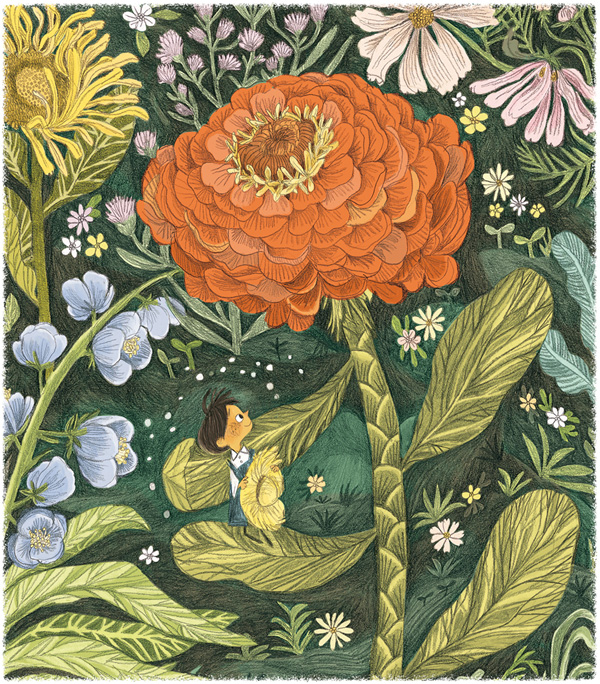 Art by Emily Hughes from Little Gardener More than a century after Alice James — Henry and William James's brilliant, underappreciated sister — observed from her deathbed that "[this] is the most supremely interesting moment in life, the only one in fact when living seems life," Lamott adds: We see this toward the end of many people's lives, when everything in their wasted bodies fights to stay alive, for a few more kisses or bites of ice cream, one more hour with you. Life is still flowing through them: life is them. […] That's magic, or the human spirit, or hope — whatever you want to call it — to captivate, to share contented time. Complement this particular portion of the wholly splendid Almost Everything: Notes on Hope with Joan Didion on learning not to mistake self-righteousness for morality and Ann Patchett on why self-forgiveness is the pillar of art, then revisit Lamott on friendship, finding meaning in a mad world, how perfectionism kills creativity, and her magnificent manifesto for handling haters. donating=lovingIn 2018, the 12th year of Brain Pickings, I poured tremendous time, thought, love, and resources into this labor of love, which remains free and is made possible by patronage. If you found any joy and consolation here this year, please consider supporting it with a donation. And if you already donate, from the bottom of my heart: THANK YOU. monthly donation You can become a Sustaining Patron with a recurring monthly donation of your choosing, between a cup of tea and a Brooklyn lunch. | | one-time donation Or you can become a Spontaneous Supporter with a one-time donation in any amount. |  | |  | | | 
After eight years of labor, it has been astonishing and heartening to witness the enthusiasm with which A Velocity of Being: Letters to a Young Reader — our anthology of illustrated letters to children about why we read from 121 of the most inspiring humans of our time — has been welcomed into the world. To honor that enthusiasm, ten artists from the book have kindly granted us permission to turn their illustrations into art prints, with all proceeds — like those from the book itself — benefitting the New York public library system. I like to think of them as the diverse contemporary counterpart of Maurice Sendak's lovely vintage posters celebrating books, libraries, and the love of reading, which were a mighty inspiration for our project. Viva books — please enjoy:  Art by Ofra Amit for a letter by Mara Faye Lethem from A Velocity of Being: Letters to a Young Reader. Get the print.  Art by Olivier Tallec for a letter by Diane Ackerman from A Velocity of Being: Letters to a Young Reader. Get the print.  Art by Violeta Lópiz for a letter by Lucianne Walkowicz from A Velocity of Being: Letters to a Young Reader. Get the print.  Art by Shaun Tan for a letter by Tom De Blasis from A Velocity of Being: Letters to a Young Reader. Get the print.  Art by Mouni Feddag for a letter by Alain de Botton from A Velocity of Being: Letters to a Young Reader. Get the print.  Art by Cindy Derby for a letter by Rose Styron from A Velocity of Being: Letters to a Young Reader. Get the print.  Art by Lia Halloran for a letter by Marina Abramović from A Velocity of Being: Letters to a Young Reader. Get the print.  Art by Catarina Sobral for a letter by Andrew Solomon from A Velocity of Being: Letters to a Young Reader. Get the print.  Art by Daniel Salmieri for a letter by David Byrne from A Velocity of Being: Letters to a Young Reader. Get the print.  Art by Sophie Blackall for a letter by Neil Gaiman from A Velocity of Being: Letters to a Young Reader. Get the print.  Cover art by Ping Zhu for A Velocity of Being: Letters to a Young Reader. Get the print. 


See more of this monumental labor of love, including a glimpse of the other 111 illustrations, here. You can claim your copy of this timeless, seasonless book from Enchanted Lion now, or pre-order it from Powell's, Amazon, or an independent bookstore of your choice. 
"Once we leave those domains of human experience, there's no reason to expect the laws of nature to continue to obey our expectations, since our expectations are dependent on a limited set of experiences," Carl Sagan observed in considering how common sense blinds us to the reality of the universe. Perhaps worse yet — worse than the wrong beliefs we held for millennia about our planet's shape, motion, and position in the cosmos, just because it feels flat and steady beneath our feet and is the center of everything we know — common sense often blinds us to the reality of our own interior world. It impoverishes our experience of the uncommonest, most delicate, most beautiful aspects of being and leads us, as I wrote in the prelude to Figuring, to mistake our labels and models of things for the things themselves. How to lift the blinders of common sense that unfit us for seeing wonder is what Vladimir Nabokov (April 22, 1899–July 2, 1977) explores with uncommon wisdom, wit, and splendor of sentiment in a lecture he delivered at Wellesley College in 1941, titled "The Art of Literature and Commonsense" and later included in the superb posthumous 1980 volume Lectures on Literature (public library).  Vladimir Nabokov Nabokov writes: In the fall of 1811 Noah Webster, working steadily through the C's, defined commonsense as "good sound ordinary sense . . . free from emotional bias or intellectual subtlety… horse sense." This is rather a flattering view of the creature, for the biography of commonsense makes nasty reading. Commonsense has trampled down many a gentle genius whose eyes had delighted in a too early moonbeam of some too early truth; commonsense has back-kicked dirt at the loveliest of queer paintings because a blue tree seemed madness to its well-meaning hoof; commonsense has prompted ugly but strong nations to crush their fair but frail neighbors the moment a gap in history offered a chance that it would have been ridiculous not to exploit. Commonsense is fundamentally immoral, for the natural morals of mankind are as irrational as the magic rites that they evolved since the immemorial dimness of time. Commonsense at its worst is sense made common, and so everything is comfortably cheapened by its touch. Commonsense is square whereas all the most essential visions and values of life are beautifully round, as round as the universe or the eyes of a child at its first circus show. This "sense made common" is, of course, the seedbed of so many of our social and civilizational biases — from the dogmatic geocentrism that nearly cost Galileo his life to the mindless majority rule against which James Baldwin so fervently admonished. It is the seedbed, therefore, of conformity and thus the enemy of a society's progress, which presupposes that we rise above the common lot of beliefs and mores to imagine the uncommon, the alternative — an act so countercultural that, throughout history, those who have dared undertake it have been punished or ostracized. Kierkegaard knew this when he contemplated why we conform and asserted that "truth always rests with the minority, and the minority is always stronger than the majority, because the minority is generally formed by those who really have an opinion, while the strength of a majority is illusory, formed by the gangs who have no opinion." Ben Shahn knew it when he observed in his fantastic Norton lectures at Harvard that "without the nonconformist, any society of whatever degree of perfection must fall into decay." With an eye to the innumerable offenses against sanity and justice perpetrated by an unquestioning adherence to so-called common sense, Nabokov adds: It is instructive to think that there is not a single person in this room, or for that matter in any room in the world, who, at some nicely chosen point in historical space-time would not be put to death there and then, here and now, by a commonsensical majority in righteous rage. The color of one's creed, neckties, eyes, thoughts, manners, speech, is sure to meet somewhere in time or space with a fatal objection from a mob that hates that particular tone. And the more brilliant, the more unusual the man, the nearer he is to the stake. Stranger always rhymes with danger. The meek prophet, the enchanter in his cave, the indignant artist, the nonconforming little schoolboy, all share in the same sacred danger. And this being so, let us bless them, let us bless the freak; for in the natural evolution of things, the ape would perhaps never have become man had not a freak appeared in the family. Anybody whose mind is proud enough not to breed true, secretly carries a bomb at the back of his brain; and so I suggest, just for the fun of the thing, taking that private bomb and carefully dropping it upon the model city of commonsense. In the brilliant light of the ensuing explosion many curious things will appear; our rarer senses will supplant for a brief spell the dominant vulgarian that squeezes Sinbad's neck in the catch-as-catch-can match between the adopted self and the inner one. I am triumphantly mixing metaphors because that is exactly what they are intended for when they follow the course of their secret connections — which from a writer's point of view is the first positive result of the defeat of commonsense. But there is a second, deeper consequence of defeating common sense. A century after Walt Whitman extolled optimism as our mightiest resistance against the corruptions of society, Nabokov frames optimism not as a luxury of privilege but as an imperative of survival. He writes: The second result is that the irrational belief in the goodness of man… becomes something much more than the wobbly basis of idealistic philosophies. It becomes a solid and iridescent truth. This means that goodness becomes a central and tangible part of one's world, which world at first sight seems hard to identify with the modern one of newspaper editors and other bright pessimists, who will tell you that it is, mildly speaking, illogical to applaud the supremacy of good at a time when something called the police state, or communism, is trying to turn the globe into five million square miles of terror, stupidity, and barbed wire. And they may add that it is one thing to beam at one's private universe in the snuggest nook of an unshelled and well-fed country and quite another to try and keep sane among crashing buildings in the roaring and whining night. But within the emphatically and unshakably illogical world which I am advertising as a home for the spirit, war gods are unreal not because they are conveniently remote in physical space from the reality of a reading lamp and the solidity of a fountain pen, but because I cannot imagine (and that is saying a good deal) such circumstances as might impinge upon the lovely and lovable world which quietly persists, whereas I can very well imagine that my fellow dreamers, thousands of whom roam the earth, keep to these same irrational and divine standards during the darkest and most dazzling hours of physical danger, pain, dust, death.  Vladimir Nabokov as a child (Nabokov Museum) Nabokov locates the antipode of common sense in "the supremacy of the detail over the general, of the part that is more alive than the whole, of the little thing which a man observes and greets with a friendly nod of the spirit while the crowd around him is being driven by some common impulse to some common goal." Speaking at the peak of WWII, as John Steinbeck is writing on the other side of the continent that "all the goodness and the heroisms will rise up again, then be cut down again and rise up," Nabokov offers: I take my hat off to the hero who dashes into a burning house and saves his neighbor's child; but I shake his hand if he has risked squandering a precious five seconds to find and save, together with the child, its favorite toy. I remember a cartoon depicting a chimney sweep falling from the roof of a tall building and noticing on the way that a sign-board had one word spelled wrong, and wondering in his headlong flight why nobody had thought of correcting it. In a sense, we all are crashing to our death from the top story of our birth to the flat stones of the churchyard and wondering with an immortal Alice in Wonderland at the patterns of the passing wall. This capacity to wonder at trifles — no matter the imminent peril — these asides of the spirit, these footnotes in the volume of life are the highest forms of consciousness, and it is in this childishly speculative state of mind, so different from commonsense and its logic, that we know the world to be good. In the remainder of this piece from his altogether magnificent Lectures on Literature, Nabokov goes on to explore how the rejection of common sense factors into the creative process and the two types of inspiration. For more of his abiding insight into art and life, see Nabokov on the three qualities of a great storyteller, what makes a good reader, and the six short stories everyone ought to read, then revisit his exquisite love letters to Véra. donating=lovingIn 2018, the 12th year of Brain Pickings, I poured tremendous time, thought, love, and resources into this labor of love, which remains free and is made possible by patronage. If you found any joy and consolation here this year, please consider supporting it with a donation. And if you already donate, from the bottom of my heart: THANK YOU. monthly donation You can become a Sustaining Patron with a recurring monthly donation of your choosing, between a cup of tea and a Brooklyn lunch. | | one-time donation Or you can become a Spontaneous Supporter with a one-time donation in any amount. | | | | | | | | | | | |


No comments:
Post a Comment